Southern Cross returned from her cruise around the
Islands, our men very busy all day cleaning the ship in the
evening we exercise Fire Quarters and prepared ship
for Sea Commissioner Woodford with wife & son came
on board with him, but during the stay on board rain
came down so heavy that they had to remain till
past 9 o clock we had a yarn with their boats
crew, which consisted of five natives belonging
to different Islands of the Hebrides Group they
seemed a very decent lot of chaps (not chaps written) speaking
English very well and greatly taken up with
their master we took them into the Marines Mess
and gave them some coffee & supper afterwards
the ships company made them presents of tobacco
& old clothing likewise we made up a decent pack-
age of tinned provisions from the canteen we
sent our Mail on shore in charge of the Commis-
sioner as no steamer would call at Gavatu till the 31st
Showing posts with label Schooner Southern Cross. Show all posts
Showing posts with label Schooner Southern Cross. Show all posts
Tuesday, 7 May 2013

Monday 9th May 1898 HMS Mohawk
Carried on a very slow process of coaling during the day
we managed to get on board about 45 tons, in the
afternoon the Southern Cross left us resuming her
cruise around the Islands, Dr Moore & Mr Scott
Navigating ??? went away in steam cutter fully
armed to attend a sick European about 12 mls
distant they remained away all night return-
ing at noon next day, two traders came on
board from 2 different islands for the purpose of
seeing the doctor they had got a attack of the fever, carried
on routine of coaling ship till the 13th.
Sunday May 8th 1898 HMS Mohawk
Sunday May 8th 1898
Our officers availed themselves of a little shooting,
but the only birds that came across ship' path was
pigeons, in the afternoon the missionaries from the
Southern Cross, came on board bringing with them
twenty of their reformed Natives belonging to different
Islands most of them spoke English very well
having been to the Mission School on Norfolk Island
which they said they liked very well indeed and
was very sorry to have to leave it, they were now
going back to their own islands to teach their own
people about Civilization & the bible, during the
the afternoon our men went away seineing for the
1st time, but was unsuccessful owing to the seine
getting foul of the coral which the bottom is cover-
ed with.
I wasn't sure if had correctly read seineing and seine.
Seining is I have discovered a type of large net fishing that is made to hang vertically in the water by weights at the lower edge and floats at the top.
I have discovered another journal at http://anglicanhistory.org/oceania/island_mission1869/25.html when searching for info on Norfolk Island Missionary schoool
Here is an extract mentioned the Schooner Southern Star
[277] CHAPTER XXV.
ON Easter Tuesday, 1867, the Southern
Cross conveyed the bulk of the Mission School, with the Bishop,
Mr. Codrington, and Mr. Bice, from Kohimarama to Norfolk Island.
Mr. Palmer had spent the summer there, and Mr. Brooke and Mr.
Atkin, with the boys under their charge, had been there for a
month; so that when the Bishop arrived there, he found his new
station in a fair state of preparation, enclosures and outhouses
ready, and all in a state of sufficient forwardness to receive
the large party who were there to be lodged.
Here is an image of the Southern Star

The image is linked for another online journal I just discovered
SANTA CRUZ AND THE REEF ISLANDS
Described by the Rev.
W. C. O'FERRALL,
Missionary in Santa Cruz, 1897-1904
http://anglicanhistory.org/oceania/oferrall_santacruz1908/
They are some excellent images here.
Our officers availed themselves of a little shooting,
but the only birds that came across ship' path was
pigeons, in the afternoon the missionaries from the
Southern Cross, came on board bringing with them
twenty of their reformed Natives belonging to different
Islands most of them spoke English very well
having been to the Mission School on Norfolk Island
which they said they liked very well indeed and
was very sorry to have to leave it, they were now
going back to their own islands to teach their own
people about Civilization & the bible, during the
the afternoon our men went away seineing for the
1st time, but was unsuccessful owing to the seine
getting foul of the coral which the bottom is cover-
ed with.
 |
| Seine net fishing - Image linked to Ohio.gov |
I wasn't sure if had correctly read seineing and seine.
Seining is I have discovered a type of large net fishing that is made to hang vertically in the water by weights at the lower edge and floats at the top.
Here is an extract mentioned the Schooner Southern Star
Here is an image of the Southern Star
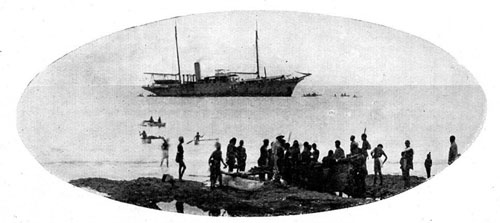
The image is linked for another online journal I just discovered
http://anglicanhistory.org/oceania/oferrall_santacruz1908/
They are some excellent images here.
Monday, 6 May 2013
Saturday 7th May 1898 HMS Mohawk
Sat 7th May (1898)
The Southern Cross got underway early in
the morning to carry on with her cruise, but
when she had got about 2 miles from us
she went on shore on a coral bank our
boats was called away and sent to her
to render any assistance which she would
require, after working all day long taking
out her stores and all heavy gear, and plac-
ing out anchors we manged to get her off
by the evening tide without any material
damage she then came back into harbour
and dropped anchor, we sent our divers
away to examine her bottom and found
it was all right only a strip of copper off
here and there just where she had touched, dur
-ing the day we were invited by the Royal Com-
issioner C. M. Woodford having his wife
& son with him they stayed on board and
lunched with our Captain and on leaving
he was saluted with 7 guns which greatly
frightened the Natives, the natives seems very
much struck with our figure head, which
is a very good representation of a Mohawk
Indian with a Tomahawk in his right
hand and a scalping knife in his left
all ready to strike out at anything, the
natives collected around the bows, talking &
making alls orts of grimaces at it, mak-
ing great fuss of the ship, they brought a
canoe full of long grass which they kept ty-
ing together till they made a line long enough
to take the measurement of the ship. We are
about the biggest and heaviest Man of War
that has been here, so no doubt they are under the
impression of building a War canoe on the same size.

Source http://www.euppublishing.com/doi/abs/10.3366/anh.1999.26.3.419
Charles Morris Woodford
First Resident Commissioner of british Solomon islands protectorate and important (forgotten) Collector of Natural specimens
born Gravesend Kent 1852, Died Steyning Essex 1927
Hi s collection of Bats is at The Natural Hisory Museum
The Southern Cross got underway early in
the morning to carry on with her cruise, but
when she had got about 2 miles from us
she went on shore on a coral bank our
boats was called away and sent to her
to render any assistance which she would
require, after working all day long taking
out her stores and all heavy gear, and plac-
ing out anchors we manged to get her off
by the evening tide without any material
damage she then came back into harbour
and dropped anchor, we sent our divers
away to examine her bottom and found
it was all right only a strip of copper off
here and there just where she had touched, dur
-ing the day we were invited by the Royal Com-
issioner C. M. Woodford having his wife
& son with him they stayed on board and
lunched with our Captain and on leaving
he was saluted with 7 guns which greatly
frightened the Natives, the natives seems very
much struck with our figure head, which
is a very good representation of a Mohawk
Indian with a Tomahawk in his right
hand and a scalping knife in his left
all ready to strike out at anything, the
natives collected around the bows, talking &
making alls orts of grimaces at it, mak-
ing great fuss of the ship, they brought a
canoe full of long grass which they kept ty-
ing together till they made a line long enough
to take the measurement of the ship. We are
about the biggest and heaviest Man of War
that has been here, so no doubt they are under the
impression of building a War canoe on the same size.
Source http://www.euppublishing.com/doi/abs/10.3366/anh.1999.26.3.419
Charles Morris Woodford
First Resident Commissioner of british Solomon islands protectorate and important (forgotten) Collector of Natural specimens
born Gravesend Kent 1852, Died Steyning Essex 1927
Hi s collection of Bats is at The Natural Hisory Museum
Proceedings of the Zoological Society of London
CM Woodford Journal
http://en.wikisource.org/wiki/Popular_Science_Monthly/Volume_35/August_1889/Life_in_the_Solomon_Islands
Extract from link mentioning Tomohawk (see diary entry)
From the trading station at Rubiana, which is the center of the head-hunting district, our first visit was to a small island occupied by another trader. This island he is allowed to occupy on sufferance only. It belongs to the natives of Sisieta; they will not sell it, as they use it for their cannibal feasts. I was told that six bodies were eaten here a fortnight before my visit. From here we went to a town called Oneavesi, and thence crossed to the small island of Rubiana proper, where we found nearly all the men away on a head-hunting expedition to the island of Isabel. I here photographed the interior of a tambu house, the post of which was carved to represent a crocodile. Along the rafters was a row of heads. I also took a photograph of a collection of sacred images, near to which was a heap of skulls, upon every one of which I

Fig. 1. — Sacred Image at Rubiana.
noticed the mark of the tomahawk.Friday May 6th 1898 HMS Mohawk
May 6th Fri
At 5am we got up anchor and proceeded
to the Florida Islands a distance of 80 miles
We arrived in the afternoon and anchored
off the island of Gavatua here we was
surrounded by canoes trading in the same
manner, only some having parrots, some of
the natives here would ask for money, but we
found out that the missionaries had put
them up to ask for it, so that they could make
them presents of it instead of there native
produce. The natives seems very friendly some
(Florida islands also known as Nggela Islands)
(Gavatua presumed to be Gavutu)
speaking a few words of broken English their
only covering being a Tshafed Loin cloth wear-
ing bone rings in their ears and round their
arms & ankles their hair being being very long and Budy?
some having it nearly white which is cause by
it being plasticised with lime, which takes all
the colour out of it for a time, when the lime is
dry they brush it out with a rough kind of
brush made out of coconut fibre, the men
are the only ones that show themselves they
keep all their wifes & children in the bush
for which the island are very thick indeed
a walk in most part being impossible in
the thickest of the bush they build their
huts living in small numbers, shortly after
we arrived we were joined by a missionary
Schooner the Southern Cross being then
on a visit around the islands she anchor-
ed close alongside of us, the trading station
on Gavatua is owned by a couple of traders
Newman and Alison keeping 3 Schooners and having
several Niggers working for them, they came
on board and gave us a lot of information about
the Solomon Islands in General, on the Island
Admiralty has 1000 tons of coal stored
under the charge of the traders for the use
of the Men of war doing duty around the islands
that was mostly our reason for visiting this
island.
Source Wikipedia
The Nggela Islands, also known as the Florida Islands, are a small island group in the Central Province of the Solomon Islands, a state in the southwest Pacific Ocean.
Gavutu is a small islet in the Central Province of the Solomon Islands, some 500 metres (550 yards) in length. It is one of the Nggela Islands.
Coordinates: 009°07′00″S 160°11′20″E
At 5am we got up anchor and proceeded
to the Florida Islands a distance of 80 miles
We arrived in the afternoon and anchored
off the island of Gavatua here we was
surrounded by canoes trading in the same
 |
| Solomon Island warriors, armed with spears, aboard an ornamented war canoe (1895) Linked from Wikipedia |
manner, only some having parrots, some of
the natives here would ask for money, but we
found out that the missionaries had put
them up to ask for it, so that they could make
them presents of it instead of there native
produce. The natives seems very friendly some
(Florida islands also known as Nggela Islands)
(Gavatua presumed to be Gavutu)
speaking a few words of broken English their
only covering being a Tshafed Loin cloth wear-
ing bone rings in their ears and round their
arms & ankles their hair being being very long and Budy?
some having it nearly white which is cause by
it being plasticised with lime, which takes all
the colour out of it for a time, when the lime is
dry they brush it out with a rough kind of
brush made out of coconut fibre, the men
are the only ones that show themselves they
keep all their wifes & children in the bush
for which the island are very thick indeed
a walk in most part being impossible in
the thickest of the bush they build their
huts living in small numbers, shortly after
we arrived we were joined by a missionary
Schooner the Southern Cross being then
on a visit around the islands she anchor-
ed close alongside of us, the trading station
on Gavatua is owned by a couple of traders
Newman and Alison keeping 3 Schooners and having
several Niggers working for them, they came
on board and gave us a lot of information about
the Solomon Islands in General, on the Island
Admiralty has 1000 tons of coal stored
under the charge of the traders for the use
of the Men of war doing duty around the islands
that was mostly our reason for visiting this
island.
Source Wikipedia
The Nggela Islands, also known as the Florida Islands, are a small island group in the Central Province of the Solomon Islands, a state in the southwest Pacific Ocean.
Gavutu is a small islet in the Central Province of the Solomon Islands, some 500 metres (550 yards) in length. It is one of the Nggela Islands.
Coordinates: 009°07′00″S 160°11′20″E

Subscribe to:
Posts (Atom)